

Question: How do the geological and climatological records of the past 15,000 years correlate with myths and legends about global floods and “resets” of human civilization?
Several distinct impulses have been delivered to the global climate over the past 15,000 years.
- The Older Dryas impulse was delivered circa 14,000 years ago and lasted about 400 years.
- The Younger Dryas impulse was delivered circa 12,900 years ago and lasted about 1,200 years.
- The Younger Dryas meltwater Pulse 1B was delivered circa 11,400 years ago and lasted about 500 years.
- The Burckle object penetrated the Indian Ocean and the underlying seafloor an estimated 4,831 years ago, and together with suspected fragmentary impacts across the globe caused widespread, possibly global deluges lasting weeks to months.
Atlantis Revisited 4: Destruction
In Plato’s Atlantis (specifically in his Timaeus), the Egyptian astronomer priest Sonchis of Sais, speaking to the Athenian statesman Solon circa 600 BCE, calls “the extraordinary inundation” that destroyed Athens, apparently contemporaneously with the destruction of Atlantis, “the third before the Great Destruction of Deucalion”.
Atlantis Revisited 5: The Illustrated Plato’s Atlantis
The Burckle Crater at the bottom of the Indian Ocean is the remnant of what scientists believe to be an oceanic comet strike circa 5,000 years ago. After this and suspected additional concurrent fragment impacts vaporized and lofted millions of tons of seawater into the stratosphere, catastrophic and persistent deluges ensued over wide areas, possibly enveloping the entire world, but certainly the world known to the regional civilizations whose traditions preserved eyewitness accounts of this event. These traditions include the Mesopotamian Deluge of Gilgamesh, the Greek Deluge of Deucalion and the Hebrew Deluge of Noah.
Atlantis Revisited 6: The Waterspout of the Chaldeans
Native American tradition appears to have preserved a memory of the Burckle event, placing it at the destruction of their “Third World” and marking the onset of their “Fourth World” in which they (and all of us) live today. “Four days passed and then a great noise was heard all around the Third World. Begochiddy knew what it was, knew what was going to happen. Someone had done wrong. Now this Third World was about to be destroyed by flood.” — Bruchac, Joseph & Caduto, Michael J. “Four worlds: The Dine Story of Creation” Native American Stories. Golden, CO: Fulcrum Publishing, 1991.
The Atlantis Revisited documentary series at GoYrOwnWay.com covers this and more in illustrious detail.
Looking back over the 600 BCE report by Sonchis of Sais, we thus have:
- The Older Dryas commencing 14,000 years ago;
- The Younger Dryas commencing 12,900 years ago, contemporaneous with the disappearance of the Clovis culture in North America;
- The Younger Dryas meltwater pulse 1B commencing 11,400 years ago, contemporaneous with the Phaëthon mythos and the destruction of Atlantis, and with “the extraordinary inundation” of Athens, Greece, “which was the third before the Great Destruction of Deucalion”;
- The Burckle impact about 5,000 years ago, contemporaneous with
- the Deluge of the Chaldeans in Babylonian tradition,
- the Great Destruction of Deucalion in Greek mythology,
- the Hebrew Deluge of Noah in the Old Testament,
- the Deluge of Gilgamesh in Mesopotamian tradition,
- the destruction of the Third World in Native American tradition,
- the Deluge of the Popul Vuh, the Sacred Book of the Central Americans and
- an outbreak of the plague bacterium, Yersinia pestis, revealing that it ravaged Eurasia 5000 years ago.
There can be little doubt that this is what Sonchis of Sais was talking about circa 600 BCE when he told Solon of Athens that “there have been, and will be again, many destructions of mankind arising out of many causes“. What he could hardly have guessed was that these destruction events were most likely the results of major bolide strikes.
Atlantis Revisited 1: Interception
But wait! Sonchis DID guess this when he told Solon about the Greek Phaeton mythos he associated with the destruction of Atlantis, “Now this has the form of a myth, but really signifies a declination of the bodies moving in the heavens around the earth, and a great conflagration of things upon the earth which recurs after long intervals“. Right then and there, Sonchis told us straight up, in the clearest language available to him based on Egyptian records of eyewitness accounts from deep time (now mostly lost to history), that civilizations have been periodically reset by major bolide strikes, and it’s taken us 2,600 years to finally start taking him seriously.
The Official Story as of 21 October 2024:
“Atlantìs nêsos (lit. ’island of Atlas’) is a fictional island mentioned in Plato’s works Timaeus and Critias as part of an allegory on the hubris of nations.”
Strike that about taking Sonchis of Sais seriously — it’s taken us 2,600 years and counting.
Research Results as of 12 October 2025:
The following directory listing (in 2 parts) chronicles in order of publication date the papers at Academia.edu uploaded since 1997 that specifically address questions surrounding the Younger Dryas Impact Hypothesis (YDIH).
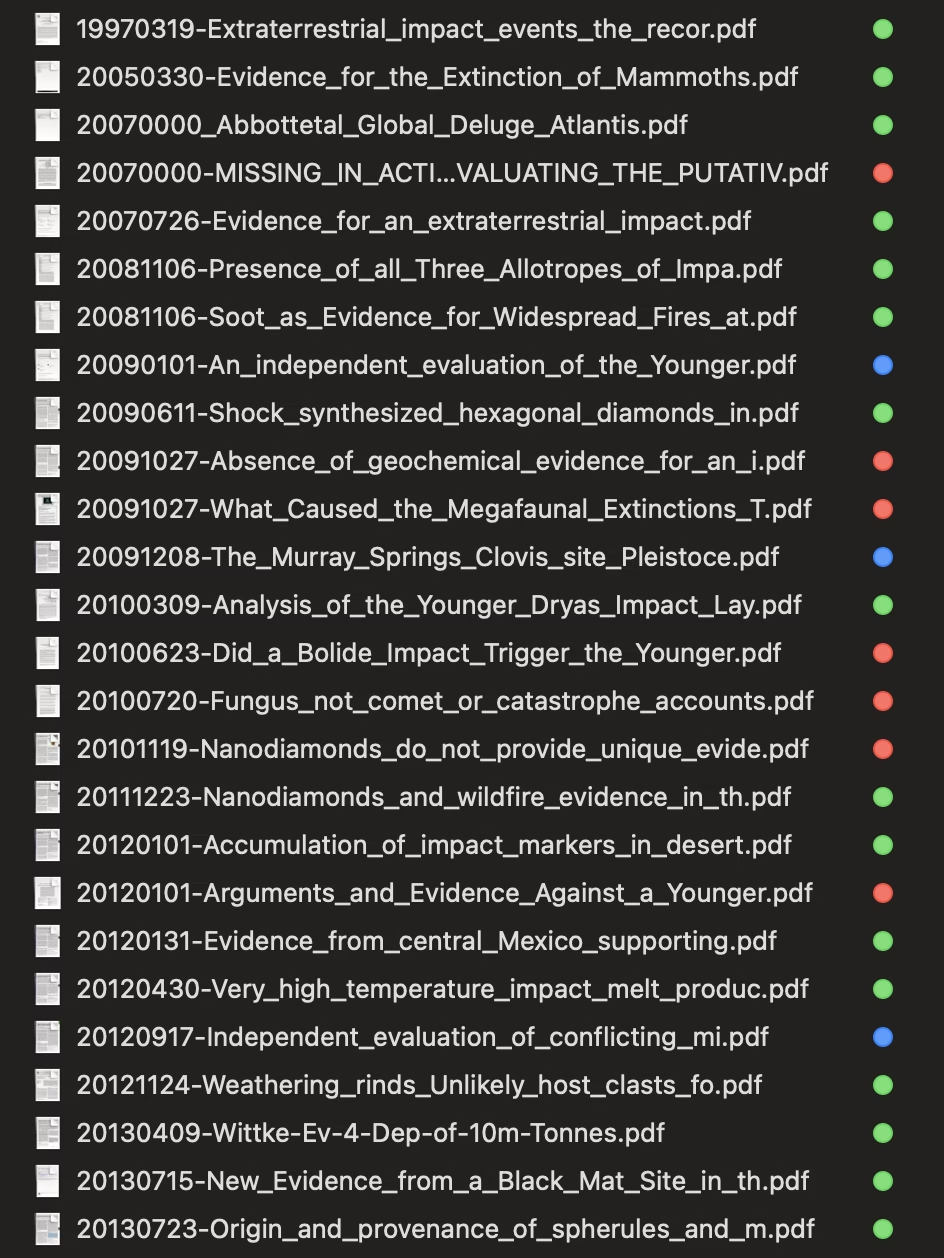
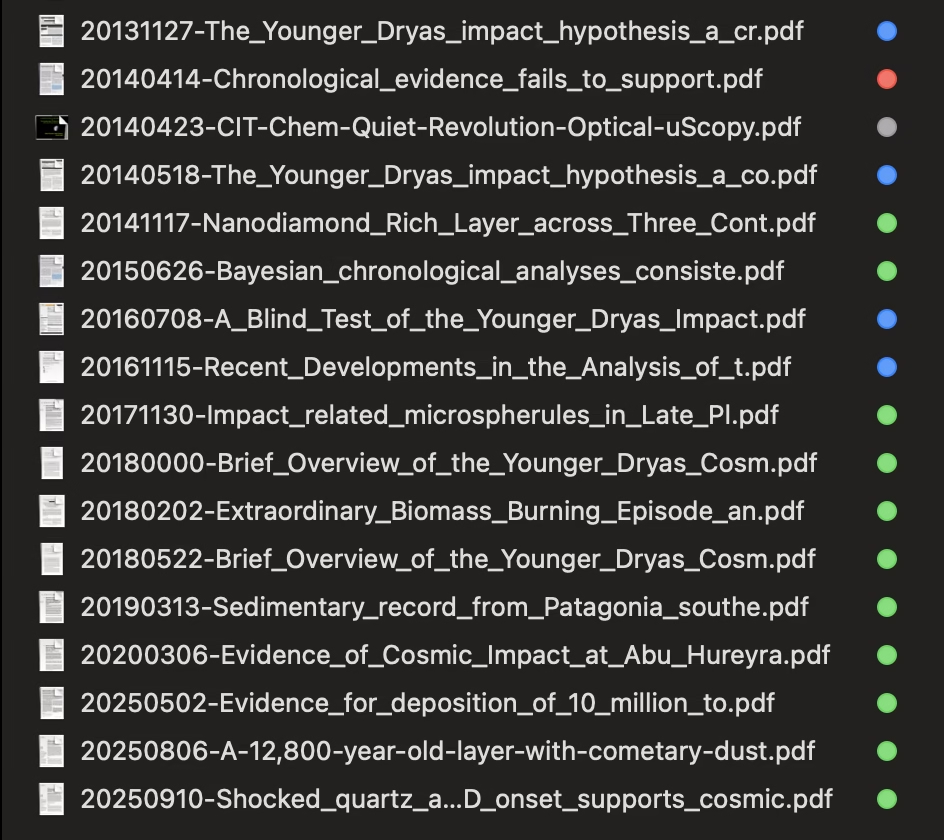
The color tags at the right of each entry encode the valence of the article as regards the Younger Dryas Impact Hypothesis (YDIH) as a legitimate causative accounting of the evidence found in the climatological and geological record:
- Papers tagged with green incline to favor the YDIH;
- Papers tagged with red incline against the YDIH;
- Papers tagged with blue are neutral on the YDIH;
- Papers tagged with gray are tangential to the YDIH;
The trend shows an ultimate inclination in favor of the Younger Dryas Impact Hypothesis as a legitimate causative accounting of the evidence found in the climatological and geological record.
If we could put this question to nature, the universe or the Solar System and its surrounds, we know very well what an honest answer would look like: “I have no clue what I’m doing, let alone the ability to prevent celestial objects from hitting one another.” Supposing we were then to present to these natural forces the text of Genesis 8:21 in the Christian Bible, to wit (KJV) “And the LORD smelled a sweet savour; and the LORD said in his heart, I will not again curse the ground any more for man’s sake; for the imagination of man’s heart is evil from his youth; neither will I again smite any more every thing living, as I have done.” To this entreaty, by far the safest assumption is that there would be no reply, so that we don’t waste time waiting for one, or if a reply is stipulated, that it would be something like “You again? Asked and answered.“
i know was said earth was destoyed by 3 elements and next will be fire, but know last oen was the flood but what was the last two? air earth water fire ether? or earth air water fire ether?
Rexx,
Thanks for your enquiry. In about 600 BCE, the Egyptian priest Sonchis of Sais told the visiting Greek Statesman Solon that “There have been, and will be again, many destructions of mankind arising out of many causes; the greatest have been brought about by the agencies of fire and water, and other lesser ones by innumerable other causes.” But Solon had no instant access to world news the way we have today. Like everyone else, his view of the world was from ground level only. There were no fancy news graphics or disaster management videos. The archives he curated in Sais were systematically compiled by the ancestors of the Egyptians of his day over thousands of years. They contained reports, no doubt some of them eyewitness accounts, of destruction events in times long past.
The result is that although the Egyptian record keeping was detailed and evidently accurate, as it was their dedicated intent to keep such records on behalf of their neighboring countries according to Sonchis, few if any of those bringing historical accounts to Sais for safekeeping would have understood the root causes of what they had witnessed.
Nevertheless, Sonchis seems to have pieced together a consistent accounting of the root causes of these catastrophes, as evidenced by his analysis of the Greek Phaeton mythos, in which Phaeton, the son of the Sun god Helios, “…having yoked the steeds in his fathers [Sun] chariot, because he was not able to drive them in the path of his father, burnt up all that was upon the earth, and was himself destroyed by a thunderbolt.” Sonchis continued to Solon, “Now this has the form of a myth, but really signifies a declination of the bodies moving in the heavens around the earth, and a great conflagration of things upon the earth, which recurs after long intervals.”
Sonchis had figured out, as best anyone could possibly have done in his day, that the root causes of many of the destruction events reported to the keepers of the archives in Sais under his care in 600 BCE, were cosmogenic, that is, originating from above, as celestial bodies fell from the sky and impacted the earth. Fortunately he gave a timeline for the destruction of Atlantis as having occurred circa 9,400 BCE. This time corresponds quite precisely to the modern-day climatological markers for the onset of the Younger Dryas meltwater pulse 1B.
“…and then occurred the the extraordinary inundation, which was the third before the great destruction of Deucalion,” Sonchis continued in his account to Solon of the destruction of Atlantis. This reinforces his analysis of the Phaeton mythos by placing it in the context of destruction events before and after the Atlantis destruction, which we are beginning to understand as corresponding to other major bolide impacts. See Timeline of Civilization Resets for the details.
If a major bolide or a fragment of a bolide lands in the ocean, the splash will case tsunamis, which Sonchis called inundations and launch potentially millions of tons of seawater into the atmosphere, which will rain out as a protracted deluge, which Sonchis recounts as the witnesses brought forth their reports for safekeeping, though few if any would have made the connection to a bolide strike. If an oceanic impact penetrates the seafloor, chunks of molten basalt and other rocks may be ejected along with the water, and will rain back down as hot molten spherules, which can cause sudden spikes in the temperature of the affected regions of the atmosphere. Sonchis describes these too in his account to Solon, though not in such detail, as do various witnesses to the Burckle impact circa 2,900 BCE according to Abbott, et. al. in their modern scientific paper. So far we have tsunamis (inundations) and catastrophic deluges (“water”) and incinerating heat pulses (“fire”). Both would have triggered the earthquakes that Sonchis also reported. If a major bolide or fragment lands on land, it will also trigger earthquakes and kick up potentially millions of tons of rock, resulting in sun blockage and long-term climate change due to the soot thus raised into the upper atmosphere, as well as the same sort of heat pulses resulting from an oceanic impact that breaches the seafloor as described above.
So whether we get more earth kicked up and molten spherules by land impacts, or whether we get more tsunamis and deluges from oceanic impacts, the most likely root causes of these modes of destruction, at least those worth writing epic legends about in the archives at Sais, are periodic major bolide strikes, “which recur after long intervals” as Sonchis put it to Solon.
Incidentally, the four elements in Dark Ages accounts were “Earth, Air, Fire and Water”. Sonchis presents his accounts in more detail than this, though all are mentioned, e.g. the land impacts produce “great conflagrations upon the earth”, the heat pulses affect the air, there is fire at impact sites or in the form of molten spherules raining back down from the stratosphere, and there is water in the form of tsunamis (inundations) and rainstorms (deluges). As to which will be experienced in a particular region of the Earth as a result of a particular impact, these can’t be known in advance without knowing precisely where the bolide will strike, with what energy and at what angle of incidence. Sometimes this is known or can be determined through computer simulations, as in the case of Apophis should it be found heading for Earth after all in the next few years… Sweet dreams! 🙂
David